
I don’t know how to start seo content writing for beginners, I have no experience. There is already a lot of competition; how will I adjust to it? This is one of the most common thoughts beginners have.
Are you thinking like this?
I also felt the same when I started writing. Whenever I opened the laptop, I thought, ” Let’s do it tomorrow, because I was also a beginner. Sometimes I was nervous about whether to publish or not. But don’t worry, I am here to tell you how I overcame it.
SEO content writing for beginners means writing high-quality, user-friendly content that easily ranks on Google. Many of you think that just about writing and publishing, but it’s not like that. You have to write valuable content that appreciates Google as well as your readers.
Many people make keyword stuffing while writing, you have to avoid them otherwise, it will great impact on your ranking. Remember, repeating the same keyword in every line makes your content spammy and looks unnatural.
The best thing is that you don’t need to buy any courses or certificates to start SEO content writing. Everybody can do it, even if you are also a beginner. There are a lot of opportunities in Seo content writing: like Remote work, freelancing, website blogging, and working with clients from any part of the world.
In this article SEO content writing for beginners, you will get a clear knowledge about how to start seo content writing with no experience, what kind of skills you need, clear difference between SEO and content writing.
How to avoid mistakes that every new seo content beginner makes.
For more information, let’s dive in.
What is SEO Content Writing for Beginners
Seo or search engine optimization content writing involves creating content that is optimised to rank on search engines to drive traffic and give the real information to readers. It is made up of two things:
Seo or search engine optimisation and Content writing.
Let’s simply understand of these two things
Content Writing
Content writing involves writing articles, blogs, and content that educate, inform, and inspire people. It focuses more on storytelling that engages more readers and focuses more on the reader rather than the search engine.
SEO
Seo contain optimesd articles that rank on search engines. These include proper titles, headings, keyword research, and internal linking. Such content is mainly created to reach the right audience whose query is related to that content.

In simple words, content writing mainly focuses on providing real information to readers, whereas SEO focuses on both readers and search engines.
When you combine both seo and content writing, it becomes seo content writing. And better chances to rank and provide more helpful information to readers.
Many people think it’s just about adding keywords, title, and meta description, and you rank on search engines. But it’s not like that. You have to understand what kind of topics people are searching for. Then write the content that is helpful for readers and properly give their answers.
Imagine someone is searching for “best dentist for children”. Now, you have to understand what the intent of the user behind this is and try to understand their problem. Then, accordingly, plan the content and structure to write. So, both the user and the search engine will understand and appreciate this. Use proper headings, title, internal linking, and images their are high chances to rank on search engines.
Why is everyone recommended to do SEO Content writing because the main purpose of
Rank on a search engine easily.
To get the right audience and give useful information.
Gain authority and trust.
If your content is good and ranks on Google but is not valuable and satisfying to the reader, there is a high chance that they will leave early. On the other side, if your content is more helpful but not seo optimised, then it won’t appear on search engines and won’t get to the right audience.
So that’s why seo content writing focuses on both readers and search engines. They work like making a food, SEO (ingredients), and content writing (recipe). When both are balanced, the food turns out very tasty.
Why SEO Content Writing is a good skill in 2026
To be honest, Seo content writing is becoming one of the biggest digital skills in 2026. Nowadays, both small and large businesses are moving online. And they need a website and online traffic to appear on Google.

Only seo content writing is an option to bring a lot of organic traffic to the website, and can rank on Google. So that’s why they need strong seo content writing to bring the organic traffic and the right customers.
1) Freelancing Opportunities
The best earning source for writers is freelancing opportunities. Because you get a lot of chances to earn, and as your experience builds, you will gain access to more earning opportunities. Most website owners and bloggers hire freelance writers to write seo content for their websites.
You can work with multiple clients rather than one. This seems best option to me because I can travel anywhere while doing work for a client — plus, I earn an income as well. All I need is a laptop and a stable internet connection. Many platforms, like freelancing and Upwork, etc., where you can get clients, with the best income.
2) Own Blog
Who wants to write their own blog on the website? Then SEO content writing is very useful for them. Find a good niche, write SEO-optimised articles, and publish them on the website.
It is the best earning source for the long term, but it will take a little bit of time to rank, like a growing tree. Just as you provide water and fertilizer, and it receives ample sunlight, it will yield good fruit.
As time passes and visitors arrive at your website daily—and as your link grows– you can earn money through ads and affiliate marketing. Therefore, this skill is strong in terms of its long-term viability and potential income.
3) Remote Work
It’s quite simple: for those who do not wish to physically commute to an office and prefer to work remotely, this is the absolute best option. This is because writing can be done from anywhere—all you need is a laptop and an internet connection.
Foreign companies, in particular, simply prioritize consistency— ensuring that articles are posted on their websites daily, without any interruptions. With this skill, you can even work with multiple clients at the same time.
4) Importance After The Arrival of AI
Most people believe that seo content writing has become extinct, just like a dinosaur, after the arrival of AI. However, they are wrong; even today, if your content is “humanized” and content filled with emotion, incorporates storytelling, and delivers valuable information to readers, then the website will rank. If your content is AI-generated, search engines will not rank it.
Since the advent of AI, writing content has become even easier. AI tools assist us by providing ideas; if you use them as your personal assistant, you will definitely achieve success.
In simple words, SEO content writing is a future-proof skill because many businesses are online and they need useful content to grow online and bring visitors. Whether you choose freelancing or blogging, it will always be a long-term career path in 2026 and beyond.
Skill You Need for SEO Content Writing for Beginners
You don’t need any prior experience–and not to be seo professional–to start this from the beginning. Beginners can improve this through practise.
You have to learn only a few skills that require; once you have mastered how to create helpful, user-intent-driven content ( simply just like making a tea), then you can drive the content without any hurdle.
1) Basic writing clarity
The first skill you need to learn is how to write your content simply and clearly so that anyone can understand. When a user comes to your website to read your content, it shouldn’t be so difficult that they are unable and feel confused to understand the content.
After all, we are writing to give information to the reader. What is the point of writing? If our content is helpful but not user–friendly. So, there is no need to write difficult words or vocabulary in your content; the simpler your content is, the more enjoyable it becomes to read.
You know what most people do? If your content is easy to understand— and they find it is informative and engaging— they will stay on the page for a long time. Otherwise, they will leave, which will cause your bounce rate to increase, and Google may think that your content isn’t helpful.
For example, just take yourself as an example as a reader: when you are watching Reels on Instagram, you scroll or leave those that don’t seem interesting or entertaining, right? And similarly, if you are watching a movie and it doesn’t entertain you, you stop watching it–don’t you? The exact same principle applies to the content.
2) Keyword research
Keyword research involves identifying the specific words or phrases that people type into Google when they are looking for information. These keywords also help Google in understanding what your content is about.
Keyword research is one of the important terms according to SEO; if once you find the right keywords, especially those with a huge search volume, it brings genuine users to your website.
Imagine that someone searches for something like “Best tools for SEO,” when you include these specific words in your content. Google will show your content in the search results. Simply, keyword research helps us identify the exact words that users are actually searching for, and you could write the content based on those words— rather than just writing about whatever comes to mind.
Since you are a beginner, you can simply use basic tools—such as Google keyword planner to find the related keywords that match the user problems. You should focus on those keywords that have a high search volume and low difficulty.
3) Understanding Search Intent
Search intent refers to the main reason behind the user’s search query. It reveals what the user aims to achieve–whether it is to solve a problem or to learn something.
When you understand the search intent, the user problem, what they are looking for, and what their aim is, then writing becomes easier. You simply need to understand the user’s problem.
For example, if someone is searching for “what is seo,” you need to understand the intent behind of this query: the user is simply wanting to collect the information rather than looking to make a purchase; they actually want to learn SEO. Therefore, you must create content accordingly.
If your content aligns with the user’s intent, the user considers that it is providing the genuine information they are seeking. Consequently, the user stays on the page longer and engages more deeply with the content. Google considers this as trustworthy and helpful content, which increases the chances of the content ranking.
4) Basic On-Page Knowledge
On-Page SEO means you have to write content that is optimised with proper headings, titles, and meta descriptions, internal linking, and appropriate images accompanied by alt text, which helps the search engines understand the content very well.
For example,
If you are writing articles, you should use headings like H1, H2, H3— as they are considered valuable by both users and search engines.
Keep your paragraphs short to ensure they are easy to read. Use keywords naturally, take care of the articles while writing, and don’t make the content more spammy.
The tiles and descriptions are the most important elements; you should aim to write a title of 50-60 characters and a description of 120-150 characters.
It’s quite simple: there is no need for you to learn things too deeply right now. At the beginning, if you learn just this much, it is more than enough; the only requirement is that the content should be optimized.
Step-by-Step How to Start With No Experience
Starting SEO content writing for beginners is a bit tough even without experience. Writers often feel hesitant while writing, which leads many people to give up. This happens because the mind tends to go blank if you do not follow a clear writing process.
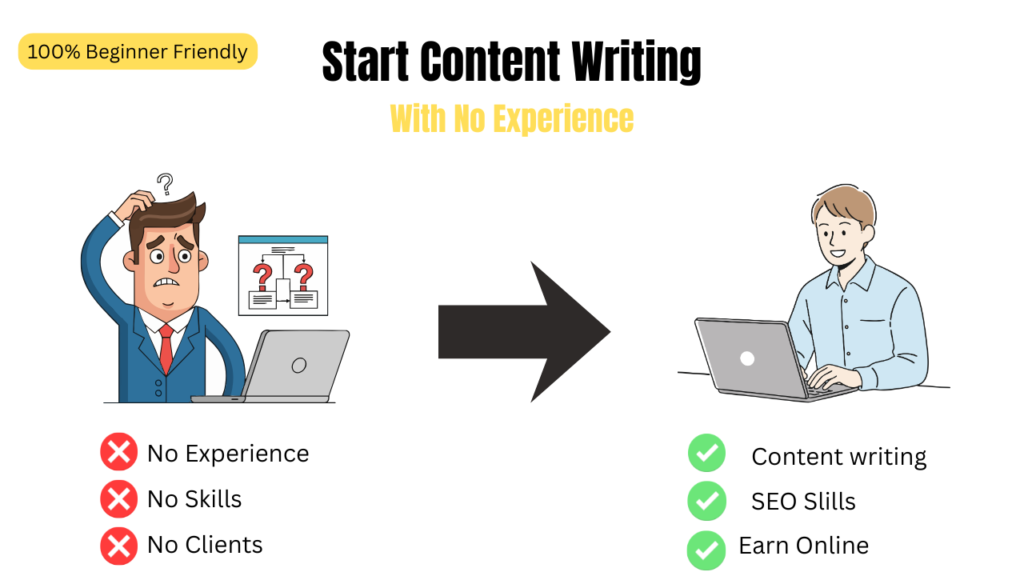
Nowadays, most people try to learn everything all at once, but this often leads to confusion; if you follow the simple step-by-step process, writing becomes much easier.
Let me tell you something simple: what if you do not follow the correct process?
Imagine you are writing an article, but do not include any elements, such as keywords or internal links, and write randomly. In that case, your article will not rank on the search engine. No matter how strong your article is, if readers can’t find your article on Google. What is the point of writing it?
We write and publish articles on our website to ensure that readers receive the right information that they are seeking on Google. This encourages them to come again, as they seem to think that they can get valuable information on this site.
As the reader arrives, our views and clicks also increase, as a result, there are so many opportunities open up for us to earn through blogging and freelancing. Therefore, if you want your content to reach the right audience, you will have to proceed strictly according to SEO guidelines.
The key is simple: you do not need to learn everything all at once. You should focus on learning one skill at a time—and practice it daily—then you, too, can write just as well as experienced professionals, without any difficulty.
1) Learn Keyword Research
As I have already explained in the above paragraph, I have covered a lot of things about what keyword research is and why it is so important in content writing. In this section, you will learn in a practical way how to find the right keywords.
Let me give you my own example. When I first started doing keyword research. I always followed two steps. Back then, I didn’t feel the need to use any other tools. Most of the time, these steps helped me find the right keywords.
First step, go to Google, just type your keyword, like “SEO tools.” Google will show suggestions; you will have to note down all of them. This will tell you what most users search on Google.
Second step, simply search for your keyword and scroll down on Google; you will find a section there titled “People Also Ask”. This will help your the real queries by the users. And you will find even more variations related to your keyword in that section.
As a beginner, you should focus on long-tail keywords like “Best SEO tools for small businesses”. Remember, you don’t need to learn advanced tools. Google searches are enough for Keywords to get started. Because you are publishing the content on Google, not anywhere else. The queries that come from Google are in high demand. If you write Content based on these keywords. It will perfectly match the user intent.
2) Analyse Top 5 Results
Once you have selected the final keyword, just type your keyword into Google. It will show you the top 5 results. Open each website individually to see what kind of topics they covered, the depth of the content, how examples are included in the articles, and how many images are in each article.
How they structure their headings, and which topics have been missed. You need to examine and analyze these results carefully, so that you get an idea of how to write a better article. This will help you to understand what Google likes, and why these articles are ranking, and what makes them special is that users keep arriving at them.
But remember one thing, you should only look at these results to get ideas; do not copy them. Otherwise, your content will become spammy and will not rank.
3) Create a Better Outline
If you create a solid outline before you start writing, creating content becomes easier. An outline works like a system that guides you on what to write and the structure in which to write it.
This ensures that you do not get confused and can cover all the relevant topics while writing. However, it helps both the search engine and users to understand the articles very well.
When you divide your articles into each section, such as introduction, headings, FAQs, and a conclusion, your article becomes fully organised. This allows you to write in the right direction. Otherwise, without an outline, you just write anything randomly and miss out on many topics.
For example, if you are writing an article, you would introduce what the article is about, specifically, what topics you will cover. The introduction should define the topic clearly.
Next, write headings under which you will explain each point with examples, and mention real data. Finally, when will you end the article with a conclusion. Just look at it, the content appears highly structured. This approach will be helpful for readers and ensure they will grab the information with clarity.
What does a reader want?
Simply to obtain information. Therefore, a good outline brings a flow to your content, connecting one section to another so that the reader can understand and absorb the information without confusion.
A clear structure not only improves readability but also increases ranking potential. When you mention headings and organize the article properly, there are more chances to rank on search engines.
4) Write User-Friendly Content
You need to start writing your article now, but there is just one thing you must keep in mind: it should be written for users, not for SEO.
Do you know what to do for mostly beginners?
They focus heavily on SEO, but forget that if your content isn’t user-friendly, writing only for SEO is useless. Success will come only when you write for people; your motivation for writing should be that whenever users visit, they leave having learned something.
Whenever you sit down to write, ask yourself a few questions,
Am I truly writing with users’ problems in mind? Are those problems actually being solved or not?
Is my explanation easy to understand?
Will the user be able to learn anything from here or not?
If your If you feel that your answer is “yes” and you keep all these things in mind while writing, then you are on the right track.
Try to write in simple language and avoid using complicated words; this will make your content feel more engaging. Additionally, include some examples and real tips in every paragraph to help the user feel a sense of personal connection.
The approach should be as if you are writing for a beginner, and they currently have no prior knowledge of your topics. And ensure that if they leave your website today, they walk away having learned something new.
5) Optimise On-Page
As I have already explained the basics in the paragraph above, how you can optimise the article. So, I will not go into too much detail about On-Page. You should know how to place the keyword naturally in the title, description, headings, etc.
I will simply tell you what needs to be done after finishing the article. Think about how you can polish content so that it can be presented effectively. You don’t need to rewrite it entirely; review it to identify whether something is missing or not.
Firstly, check if your content is too lengthy. Then make it short and ensure that it is easy to read. Nowadays, if readers see a long paragraph, they simply scroll past. The heading should clearly indicate what each section aims to tell. This helps both users and search engines understand the content
Common Beginner Mistakes
Most of the time, when we learn a new skill, we make a lot of mistakes. Perhaps even professional writers made these same errors when they were in their initial stages.
Similarly, when beginners write their first 4 or 5 articles, they commit numerous mistakes—errors that have a direct impact on the article’s ranking.
For example, when you are learning to cook, the food might turn out a bit spicy at first, or sometimes it might end up with too much salt; however, if you figure out exactly how to add the spices, the food becomes even better and tastier.
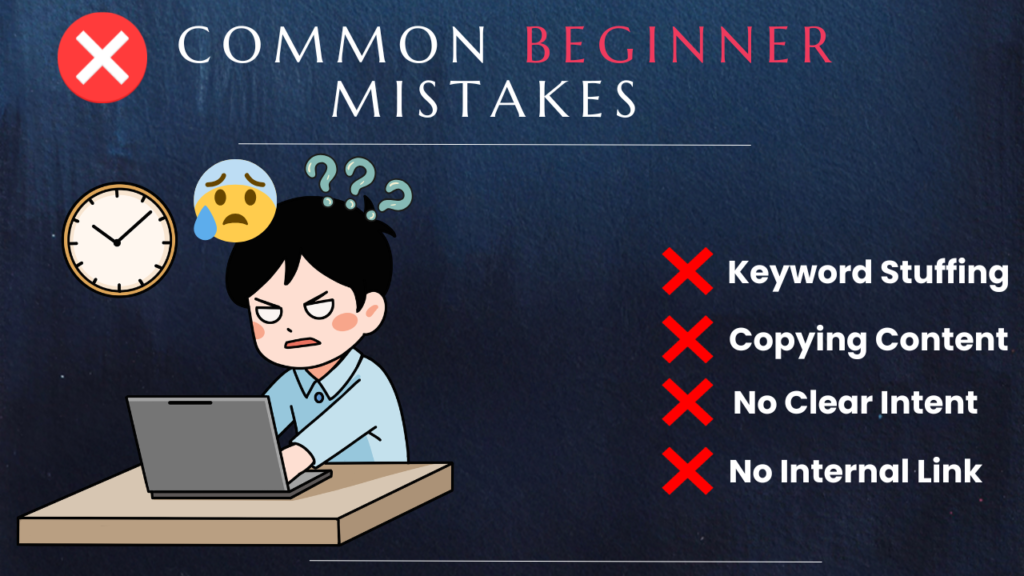
If you grasp how to avoid such mistakes, it will be highly beneficial for you, and you won’t face any difficulties in getting your article ranked. Let me tell you: beginners tend to repeatedly make the very same mistake.
1) Keyword Stuffing
I have heard a lot about “keyword stuffing,” and it seems that beginners, in particular, are frequently using it. It essentially means using the primary and secondary keywords within an article again and again.
However, this is a mistake; doing so can actually cause your article’s ranking to drop. I, too, used to believe that the more keywords I included, the more likely they would be to catch Google’s attention and achieve a high ranking.
However, this is incorrect; it reduces the readability of the article and makes it feel unnatural.
For example, suppose you are writing an article titled “How to Make South Indian Food,” and your main keyword is “South Indian Food.” If you use this keyword repeatedly in every single paragraph, the user will lose interest and find the content unengaging to read. It feels unnatural. Furthermore, Search Engines may see the content quality as quite poor.
Now, you must keep keywords in mind—but avoid overusing them. Use them only where they fit naturally. If you have understood their potential downsides and how to use them correctly, your content will undoubtedly be helpful and easy to read.
2) Copying Competitors
The most common mistake beginners make is copying other people’s content. This is a huge error.
Instead of simply drawing inspiration from top-ranking Google articles, beginners often copy everything—including the exact headings and content.
They assume that by doing so, their own articles will also rank. However, they overlook that copied content provides no unique value.
Google always prefers content that is original and offers explanations of higher quality than others.
Instead of copying, you should collect the ideas and analyze what your competitors are doing right that allows their articles to rank. Then, create content that stands out—write it in your own unique style.
3) Writing Without Search Intent
As I have already explained the concept of search intent above, here I will discuss what happens if we write articles without search intent.
For example, if you are going to a beautiful place—and you even know how to drive—but you don’t know the route, you will just keep wandering around and will never reach your final destination.
The situation is much the same with articles: most beginners select keywords but fail to understand the underlying user intent, yet they continue writing regardless. For instance, a user might be seeking information, while we are writing content focused on purchasing.
Ultimately, these articles get published but fail to rank; after all, if you write without truly understanding the user’s problem, how can you expect to generate views or attract traffic? Therefore, you should always write in alignment with the user’s intent.
Therefore, the best option is to think before you write: “Will this solve the user’s problem?” If the answer is yes, then go ahead and write it.
4) No Internal Linking
Just as a phone needs a charger to fully charge, ensuring that it lasts the entire day. Similarly, connecting one article to another is important to strengthen the structure of a website.
However, many beginners overlook this fact; they ignore internal linking. They fail to realize just how significant an impact the absence of internal linking has on both users and SEO.
For example, suppose you have written one article on SEO and are currently writing a second one on keywords. You have likely already included some points related to keywords within your SEO articles. If you simply create an internal link from the SEO article to the keyword article, users will be able to access the information with ease.
This method gives you two benefits. The first is that users can easily navigate to other articles, and the second is that Google’s crawlers can easily scan those other articles.
If you have understood just how important internal linking is from an SEO perspective, you can become a good content writer.
Frequently Asked Questions
What is SEO content writing?
SEO content writing involves creating content that is helpful to the reader and well-optimised for search engines. This includes keyword research, understanding search intent, headings, and On-page SEO.
Can beginners learn SEO content writing?
Yes, even a beginner can learn SEO content writing through daily practice. No degree or prior experience is required for this.
Is SEO content writing still useful after AI?
Yes, SEO content writing remains useful because search engines prefer valuable, humanized content over robotic text. While we can take ideas from AI, humanized content still matters.
How long does it take to learn SEO content writing?
It totally depends on you specially how you practice and how much attention you give to it. Mostly, beginners learn within a few weeks if they keep writing daily.
Do I need paid tools to start SEO content writing?
No, beginners can start using free tools like Google Search, Google Keyword Planner, and a free blogging platform.
Final Thought :
SEO content writing for beginners can be confusing; at times, you might feel like giving up everything, especially when you have zero experience. However, remember this: every experienced writer was once a beginner, and they also must have felt the same issue. It doesn’t matter how much you already know; the key point is how you adapt to the process and work on improving your skills.
You don’t need any perfect skills, nor do you need to purchase any tools; if you possess even a little knowledge about SEO and keywords, that is sufficient. With practice—and as time goes by—your skills will naturally improve.
The objective of SEO content writing is not merely to rank on Google; rather, it involves solving a real problem for someone through your words and guiding the user in the right direction—ensuring that anyone who comes to read your article leaves having learned something. A good content writer always keeps in mind exactly who they are writing for. If you write daily, continue learning, and apply what you have learned on a daily basis, you will see your achievements after some time.
Now, don’t just read this article and walk away; you have a task to complete.
Choose a simple niche,
select your keywords,
Apply the same techniques I taught you above, and write your first article. Yes, I admit that you will likely face many difficulties while writing, and your first article might not turn out perfectly—but just take that small first step. You will see real progress after writing a few articles.
If you want to improve your writing faster, check out my detailed guide on how to practise SEO content writing at home.